

This $20/Month AI Model Just Became Free — Claude Opus 4.7 on Amazon Bedrock
What if you could use one of the world’s most powerful AI models — completely free?
Until recently, access to enterprise-grade AI like Claude Opus 4.7 would cost businesses hundreds or even thousands of dollars a month in API fees. It was a tool built for big companies with big budgets — not for students, freelancers, or small business owners.
That just changed.
On April 16, 2026, Amazon Web Services (AWS) announced that Claude Opus 4.7 — Anthropic’s most intelligent and capable model — is now available on Amazon Bedrock, with a free Quickstart tier that lets anyone generate an API key and start using it in minutes. No credit card stress. No enterprise contract. Just you and one of the most advanced AI models ever built.
In this post, we break down exactly what Claude Opus 4.7 is, what it can do, and how you can start using it for free today — in plain language, no jargon.
What Is Claude Opus 4.7?
Claude Opus 4.7 is the latest AI model from Anthropic — the company behind the Claude family of AI assistants. Think of it as a highly intelligent digital brain that can write code, analyse documents, answer complex questions, and carry out long multi-step tasks — all on its own.
The “Opus” series represents Anthropic’s most capable and powerful models, designed for serious, professional workloads. Opus 4.7 is an upgrade from the previous Opus 4.6 model, bringing smarter reasoning, better accuracy, and new capabilities like high-resolution image understanding.
What Is Amazon Bedrock?
Before diving into what’s new, here’s a quick explanation for beginners.
Amazon Bedrock is a service from AWS (Amazon Web Services) that lets businesses and developers access powerful AI models — including Claude — through a simple API. Instead of building AI from scratch, companies can plug Claude directly into their own apps, websites, and workflows using Bedrock’s infrastructure.
Think of it like renting a supercomputer brain for your business, without having to build or maintain it yourself.
Seeing It in Action — Claude Opus 4.7 on Amazon Bedrock
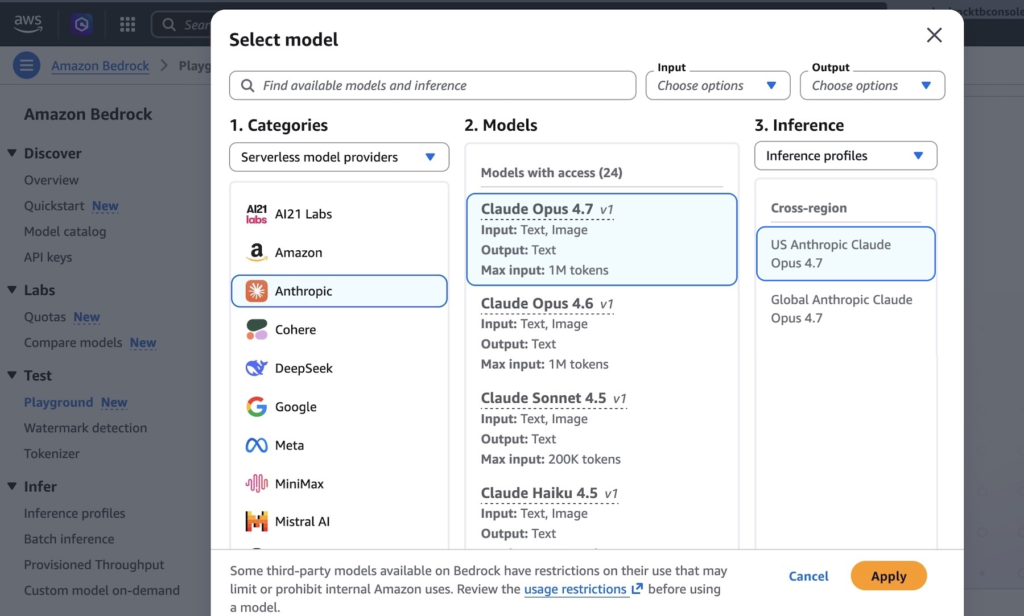
Here’s what it actually looks like when you open Amazon Bedrock’s model selection screen. Claude Opus 4.7 sits right at the top of Anthropic’s model list, alongside Opus 4.6, Sonnet 4.5, and Haiku 4.5 — with support for both Text and Image inputs and a massive 1 million token context window.
Amazon Bedrock’s model selector — Claude Opus 4.7 is now the top Anthropic model available, supporting Text and Image inputs with a 1 million token context window.
What’s New in Claude Opus 4.7?
Claude Opus 4.7 brings major improvements across four key areas. Here’s what changed and why it matters:
1. Agentic Coding — AI That Writes Complex Code Autonomously
This is perhaps the biggest upgrade. Claude Opus 4.7 is now one of the best AI models in the world at agentic coding — meaning it can write, test, debug, and manage code on its own over long periods without constant human input.
The numbers back this up. According to Anthropic, the model scores 64.3% on SWE-bench Pro, 87.6% on SWE-bench Verified, and 69.4% on Terminal-Bench 2.0 — all industry benchmarks for measuring AI coding ability.
To show just how powerful this is — here’s a real example from the Amazon Bedrock Playground. We asked Claude Opus 4.7 to design a complete distributed AWS architecture in Python capable of handling 100,000 requests per second across multiple geographic regions. The result? A fully structured, production-ready architecture — delivered in seconds.
Claude Opus 4.7 in the Amazon Bedrock Playground — asked to design a 100K RPS distributed architecture, it responded with a complete, detailed solution including Route 53 geo-routing and CloudFront edge caching.
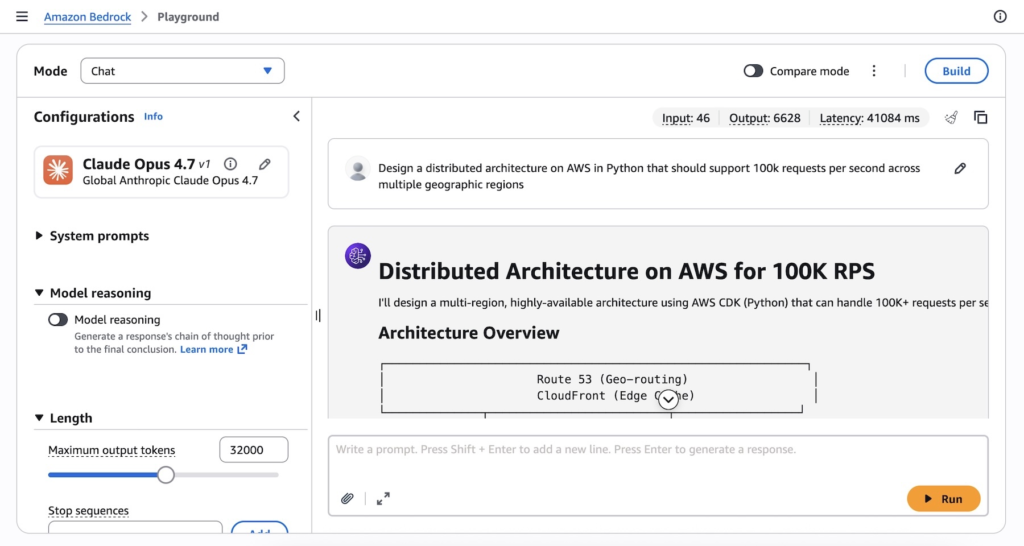
In plain English: if you ask it to build a complex software system, it won’t just write a few lines and stop. It will think through the entire problem, handle ambiguity, and deliver a complete solution.
2. Knowledge Work — Smarter Document & Research Handling
Claude Opus 4.7 is significantly better at professional knowledge tasks — things like writing detailed reports, analysing financial data, and conducting multi-step research.
What makes it stand out is its ability to handle underspecified requests. If you give it a vague or incomplete question, instead of giving up or giving a generic answer, it makes sensible assumptions, states them clearly, and then self-verifies its output before giving you the result.
The model achieves 64.4% on Finance Agent v1.1, a benchmark for financial reasoning tasks — making it a strong tool for finance professionals and analysts.
3. Long-Running Tasks — Staying Focused Over a 1 Million Token Window
One of the long-standing weaknesses of AI models is that they “forget” things over long conversations or documents. Claude Opus 4.7 addresses this with stronger performance across its full 1 million token context window.
What does that mean practically? You can give it an entire book, a large codebase, or a lengthy research paper — and it will stay on track, reasoning through complexity without losing focus or accuracy.
4. Vision — High-Resolution Image Understanding
Claude Opus 4.7 now supports high-resolution image input, making it significantly better at reading and interpreting charts, dense documents, and screen interfaces where fine detail matters.
This is particularly useful for businesses that need AI to analyse dashboards, financial charts, product screenshots, or scanned documents with precision.
How to Try Claude Opus 4.7 for Free — Step by Step
Getting started is genuinely simple — even if you’ve never touched an API before. Here’s what the free Quickstart screen looks like inside Amazon Bedrock:
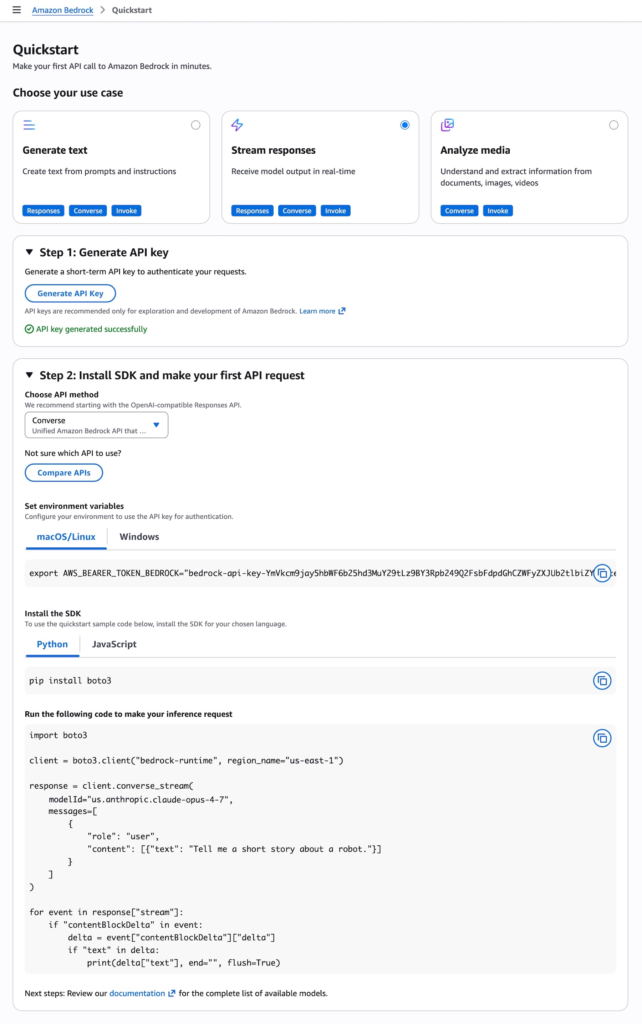
Amazon Bedrock’s Quickstart page walks you through generating a free API key and making your first Claude Opus 4.7 API call in minutes — with ready-to-run Python and JavaScript code included.
Follow these steps to get started for free today:
Step 1 — Go to console.aws.amazon.com/bedrock and sign in with your free AWS account
Step 2 — Click Quickstart in the left navigation panel
Step 3 — Choose your use case — Generate Text, Stream Responses, or Analyse Media
Step 4 — Click Generate API Key — AWS creates a free short-term key instantly, no billing required for testing
Step 5 — Install the SDK with a single terminal command:
pip install boto3Step 6 — Copy and run the sample code provided — you’re making your first Claude Opus 4.7 API call in minutes
Don’t want to write any code? Use the Playground instead — it’s a browser-based chat interface where you select Claude Opus 4.7 and start prompting immediately. Zero setup required.
Why Amazon Bedrock — Not Just Anthropic.com?
Great question. Here’s why running Claude through Amazon Bedrock is different and more powerful for businesses:
Enterprise-Grade Infrastructure: Bedrock’s new inference engine dynamically allocates computing capacity to requests, improving availability and handling sudden spikes in demand without crashing.
Zero Operator Access: This is crucial for businesses handling sensitive data. Customer prompts and responses are never visible to Anthropic or AWS operators — your data stays completely private.
Massive Scaling Capacity: Up to 10,000 requests per minute per account per region are available immediately, with more available on request.
Global Availability: Claude Opus 4.7 is live in these regions right now:
- US East (N. Virginia)
- Asia Pacific (Tokyo)
- Europe (Ireland)
- Europe (Stockholm)
Who Should Use Claude Opus 4.7?
You don’t need to be a developer or a large company to benefit from this. Here’s who gains the most:
Developers & Engineers — Opus 4.7’s agentic coding capabilities can handle complex, long-horizon software engineering tasks with minimal supervision, saving hours of work daily.
Business Owners & Startups — Automate knowledge work — research, financial analysis, report writing, customer support — at a scale that wasn’t previously affordable.
Finance Professionals — Get an AI that genuinely understands complex financial documents and can reason through multi-step analysis with high accuracy.
Students & Researchers — Process massive amounts of information — entire textbooks, research papers, or datasets — and get intelligent summaries and answers instantly.
Is It Worth Upgrading from Claude Opus 4.6?
If you’re already using Claude Opus 4.6, here’s the honest answer: yes, but with a note of caution.
Anthropic themselves acknowledge that Opus 4.7 is an upgrade that may require prompting changes and workflow tweaks to get the most out of it. It’s not a simple plug-and-play replacement — you may need to adjust how you write prompts.
That said, the performance improvements — especially in agentic coding, long-context tasks, and financial reasoning — make the upgrade worthwhile for any serious professional use case.
The Bigger Picture — Why This Matters in 2026
Claude Opus 4.7 on Amazon Bedrock represents something bigger than just another model release. It signals a clear direction for where AI is heading:
Away from human-in-the-loop AI — where humans constantly guide and correct the model — and toward fully agentic AI, where models independently plan, execute, and self-verify complex tasks over long periods.
This shift has enormous implications for jobs, businesses, and productivity. AI is no longer just a tool that answers questions. It’s becoming a system that can run entire workflows on its own.
And the fact that this level of AI is now free to try means the barrier to benefiting from it has never been lower — for anyone, anywhere.
Final Thoughts
Claude Opus 4.7 landing on Amazon Bedrock is a genuinely significant moment in AI. It’s faster, smarter, more capable, and now backed by Amazon’s world-class infrastructure — with a free entry point that removes every excuse not to try it.
Whether you’re a developer, a business owner, a student, or simply someone curious about where AI is heading — Claude Opus 4.7 is worth exploring today.
The future of AI isn’t just about chatbots answering questions. It’s about autonomous systems doing real, complex, high-stakes work. And with free access now available, there’s never been a better time to get ahead of the curve.
Content Source: AWS News Blog
Also Read: Why I Switched From ChatGPT to Claude (Without Losing Anything)